

How to Choose an Orthopedic Dog Bed That Actually Helps
Table of Contents
- Why the Right Orthopedic Dog Bed Matters for Joint Health
- Signs Your Dog Needs an Orthopedic Bed
- Memory Foam vs Egg Crate Dog Beds: What's the Real Difference?
- Step 1: Measure Your Dog for the Correct Bed Size
- Step 2: Match Foam Thickness and Density to Your Dog's Weight
- Step 3: Check the Cover, Liner, and Base for Daily Use
- How to Manage Arthritis in Large Dogs Beyond the Bed
- The Bottom Line: Choosing a Bed Your Dog Will Actually Use
- Frequently Asked Questions
Last Updated: September 6, 2026
Why the Right Orthopedic Dog Bed Matters for Joint Health
An orthopedic dog bed is a therapeutic sleeping surface designed to relieve pressure on joints, support spine alignment, and improve comfort for dogs with arthritis, hip dysplasia, or age-related stiffness. The difference between a standard cushion and a true orthopedic bed comes down to the foam core: memory foam contours to your dog's body, distributing weight evenly so no single joint bears the full load through the night.

A quality orthopedic bed cradles pressure points like the hips and elbows while maintaining enough firmness to keep the spine aligned.
Signs Your Dog Needs an Orthopedic Bed
Clear indicators it's time to upgrade include difficulty rising, hesitating before stairs, favoring one leg, stiffness after rest, or excessive circling before lying down.
Large and giant breeds, German Shepherds, Labradors, Golden Retrievers, Rottweilers, carry significant weight across their joints, making pressure relief essential even in younger years. Senior dogs over seven typically benefit regardless of breed.
Memory Foam vs Egg Crate Dog Beds: What's the Real Difference?
Memory foam is a viscoelastic material that responds to body heat and pressure, molding to your dog's shape and evenly distributing weight. Egg crate foam uses a patterned surface with peaks and valleys that provides modest cushioning but lacks memory foam's contouring properties.
For dogs with arthritis, hip dysplasia, or mobility issues, memory foam is the clear winner, reducing pressure on specific joints by spreading weight across a larger surface area. Egg crate foam may suffice for young, healthy dogs or travel, but it compresses quickly and offers minimal pressure point relief.
Beyond the Basics: Foam Density and ILD Ratings
Two specifications separate therapeutic foam from foam that merely carries the label: density and ILD (Indentation Load Deflection).
Density, measured in pounds per cubic foot (lb/ft³), indicates how much material is packed into the foam. Higher density means more support and longer lifespan. For orthopedic dog beds, look for foam rated at 3 to 5 lb/ft³; foam below 2 lb/ft³ is often low-quality 'rebond' or polyurethane that develops permanent body impressions within months. Budget beds often market 'memory foam' without publishing density, a red flag.
ILD measures firmness, the force (in pounds) required to compress a foam sample by 25%. A lower ILD (10-12) feels soft and plush; a higher ILD (14-16) feels firmer. For dogs, the ideal is medium-firm: soft enough to contour around hips and elbows, but firm enough to prevent sinking to the floor. An ILD that's too low offers poor spinal alignment, especially for heavier dogs.
The 'Recovery Rate' Test You Can Do at Home
Press your palm firmly into the foam for five seconds, then release. High-density memory foam should take 2 to 5 seconds to spring back (nist.gov). If it snaps back instantly, it's likely low-density polyurethane; if it takes longer than 10 seconds or leaves a visible indent, the foam is too soft or already degraded.
Why 'Medical Grade' Claims Need Scrutiny
'Medical grade' has no standardized definition in the foam industry. What matters is whether the foam is CertiPUR-US® certified or meets similar third-party standards for content, emissions, and durability, ensuring it's free from heavy metals, phthalates, and formaldehyde, critical since dogs spend hours with their noses pressed against the bed (certipur.us).
The Longevity Factor: What 'Compression Set' Means for Your Wallet
Foam degrades through compression set, the permanent loss of height and support after repeated use. High-density foam (4-5 lb/ft³) typically maintains its structure for 3-5 years; lower-density foam may sag within 6-12 months. Consider cost per year of effective support: a $150 bed lasting 4 years beats an $80 bed needing yearly replacement.
Step 1: Measure Your Dog for the Correct Bed Size
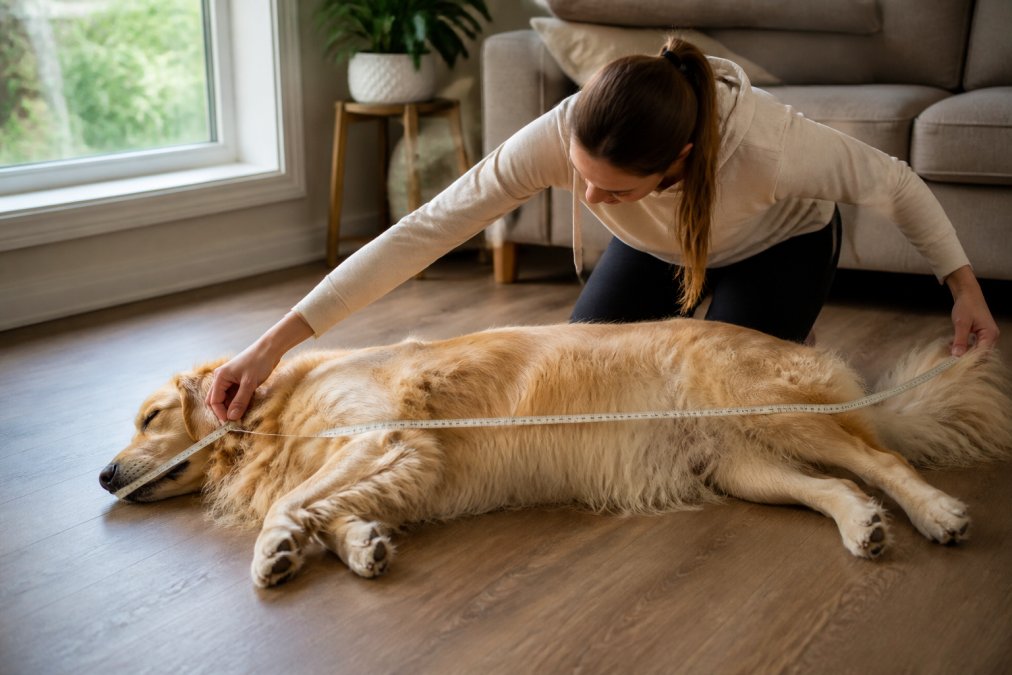
The most common sizing mistake is buying based on weight rather than stretched-out length. Measure from nose to the base of the tail while your dog lies in their natural sleeping position, then add 10 to 15 centimeters so they can fully stretch without hanging off the edge.
Consider sleeping position: dogs that curl up can manage with a smaller bed, while sprawlers need the full length plus generous clearance. A bed that's too small forces unnatural positions, reducing the therapeutic benefit of the foam.
Beyond Length: Breed-Specific Body Architecture
Generic length-based sizing misses a critical variable: body shape. Two dogs of the same weight can have completely different orthopedic needs based on skeletal structure.
Deep-chested breeds, Greyhounds, Great Danes, Dobermans, Boxers, have a narrow ribcage and significant height-to-width ratio. When lying on their side, their sternum bears considerable pressure. These dogs benefit from a thicker foam layer in the center third of the mattress, or a bolster that supports head and neck at a natural angle without straining the cervical spine.
Long-backed breeds, Dachshunds, Corgis, Basset Hounds, are prone to intervertebral disc disease (IVDD). Their spine needs continuous, even support along its entire length; a bed that's too short forces them to curve their spine, aggravating disc issues. Prioritize a bed at least 1.5 times their body length (nose to tail base) to allow full spinal extension.
Bulky or barrel-chested breeds, Bulldogs, Pugs, have a wide stance and heavy front quarters, often sleeping with front legs extended. Measure not just nose-to-tail but also chest width at the widest point; a bed that's too narrow forces front legs to dangle, reducing circulation and causing frequent waking.
The 'Two-Dog Rule' and Multi-Dog Households
If multiple dogs share a bed, measure the largest dog and add 20-25% to the dimensions. Co-sleeping dogs sprawl more than they would alone, and a cramped bed leads to one dog choosing the floor or being left on the less-supportive edge.
Sizing Reference by Weight and Body Type
| Dog Weight | Stretched Length | Recommended Bed Size | Notes |
|---|---|---|---|
| Under 20 lbs | Up to 24 inches | 24 x 18 inches | Suitable for most small breeds; consider extra depth for long-backed breeds |
| 20-40 lbs | 24-32 inches | 30 x 22 inches | Standard medium; check chest width for barrel-chested breeds |
| 40-70 lbs | 32-40 inches | 36 x 28 inches | Most common size; deep-chested breeds may need extra center thickness |
| 70-100 lbs | 40-48 inches | 44 x 32 inches | Large; long-backed breeds should size up to 48 inches |
| 100+ lbs | 48+ inches | 52 x 36 inches or larger | Giant breeds often need custom dimensions; verify foam ILD is appropriate |
When to Size Up: The 'Senior Adjustment' Factor
Senior dogs often lose hindquarter muscle mass, making hips and elbows more pronounced. A bed that fit them at age 3 may no longer cushion adequately at age 10, even at the same weight. If your senior dog hesitates to lie down or shifts frequently, measure again, they may need a larger size to spread weight over more foam.
Step 2: Match Foam Thickness and Density to Your Dog's Weight
Foam thickness directly determines support. A 3-inch layer suits dogs under 40 pounds; medium breeds (40-75 pounds) need at least 5 inches; large dogs over 75 pounds require 7 inches or more to prevent bottoming out.
Weight and foam density are equally critical. A heavy dog on low-density foam compresses it to near-flatness, eliminating pressure-relieving properties. High-density foam maintains structure under significant weight, specifications matter more than marketing language.
For large and giant breeds, a 7-inch memory foam mattress with density suitable for 75 to 120 pounds provides necessary support. The foam should recover its shape within seconds of pressure removal; beds that stay compressed after your dog stands up have exceeded their lifespan.
Step 3: Check the Cover, Liner, and Base for Daily Use
The cover determines how well the bed survives daily life, especially for senior dogs with accidents or drooling. Look for a removable, machine-washable cover made from durable microsuede or similar fabric that resists claw damage while staying soft. Washability is essential for hygiene and odor control.
A water-resistant liner between cover and foam core provides critical protection. Without it, urine from incontinent senior dogs penetrates the foam, causing permanent odor and structural degradation. The liner should be separate from the outer cover so you can wash the cover while the liner protects the foam.
A non-slip bottom prevents the bed from sliding on hardwood or tile when your dog jumps on or off, reducing fall risk for dogs with mobility issues. Check whether the bed sits flush with the floor or has a raised edge that could trip an unsteady senior dog.
How to Manage Arthritis in Large Dogs Beyond the Bed
An orthopedic bed is foundational for arthritis management but works best as part of a comprehensive approach. Weight management is critical, every extra kilogram adds measurable stress to arthritic joints (avma.org). Consult your veterinarian about a target weight and adjust portions accordingly.
Moderate, consistent exercise maintains muscle mass that supports joints. Short, frequent walks on soft surfaces are preferable to occasional long hikes on pavement. Swimming provides excellent low-impact exercise without joint compression, if your dog tolerates water.
Supplements containing glucosamine, chondroitin, and omega-3 fatty acids may support joint health, though effectiveness varies. Always discuss supplements with your veterinarian first. Anti-inflammatory medications, physical therapy, and acupuncture are additional options many owners find beneficial under veterinary guidance.
The Bottom Line: Choosing a Bed Your Dog Will Actually Use
An orthopedic dog bed is an investment in comfort and long-term mobility. Verify foam thickness matched to your dog's weight, high-density memory foam construction, a removable washable cover, and a water-resistant liner. Beds that check these boxes typically last several years.
For large and giant breeds, the Barker Beds XL Orthopedic Dog Bed from NovelPet Store provides a 7-inch memory foam mattress designed specifically for dogs between 75 and 120 pounds, with a washable cover and veterinary recommendation. The Giant option extends support to dogs up to 300 pounds at 60 by 48 inches. Both are Made in USA with materials built for durability.
Smaller dogs don't need the same foam depth but still benefit from orthopedic support. The Chester Small Dog Bed offers a memory foam mattress with bolster walls for neck support, a water-resistant liner, and a non-slip bottom at a more accessible price point.

When you choose based on your dog's specific measurements, weight, and health status, the decision becomes straightforward. Measure correctly, verify foam specifications, and prioritize washable, water-resistant construction. Your dog's joints will thank you with better sleep and easier mornings.
Frequently Asked Questions
Do orthopedic dog beds make a difference for arthritic dogs?
Yes. An orthopedic dog bed with high-density memory foam distributes weight evenly, which reduces pressure on joints like hips and elbows. For dogs with arthritis or hip dysplasia, this support can ease discomfort when lying down and make getting up less painful. The key is choosing a bed with foam that does not flatten quickly, so the support lasts beyond the first few months.
How thick should an orthopedic dog bed be?
For most medium to large dogs, a 7-inch thick memory foam mattress provides adequate support. A thicker bed is not always better if the foam density is low. What matters is that the foam supports your dog's weight without compressing fully to the floor. If your dog is over 75 pounds, look for a bed with at least 7 inches of high-density foam.
How is a memory foam dog bed different from an egg crate one?
Memory foam is a solid block that contours to your dog's body and springs back slowly, offering consistent pressure relief. Egg crate foam has a wavy surface that provides some cushioning but compresses more easily under heavier dogs. For senior dogs with arthritis, memory foam is the better investment because it maintains its shape and firmness for years.
What should I look for in a washable orthopedic dog bed?
You need a removable, machine-washable cover plus a water-resistant liner underneath. The liner protects the memory foam from accidents and moisture, which is a common reason beds get ruined. A non-slip bottom also keeps the bed stable. Check that the zipper is sturdy, since you will be removing and washing the cover regularly.
Choosing the right orthopedic bed requires matching foam density, thickness, and size to your dog's specific needs, and NovelPet Store carries vet-recommended, Made in USA options that meet those standards. Our memory foam beds for large and giant breeds feature washable covers, water-resistant protection, and the therapeutic support senior dogs need for joint pain and arthritis relief. Get started with NovelPet Store and give your dog the supportive, comfortable rest they deserve.